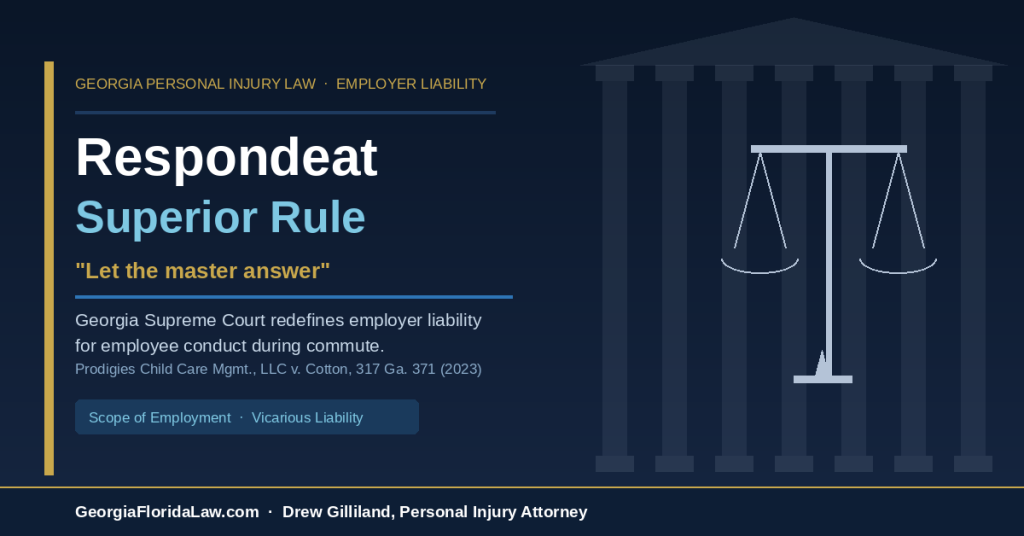
In Prodigies Child Care Mgmt., LLC v. Cotton, 317 Ga. 371 (2023), the Georgia Supreme Court changed the law regarding respondeat superior. Or, more accurately, they clarified the law. In Prodigies, the defendant employee worked at a daycare center and was taking college courses on early childhood development. She got a one-hour lunch break every day that was unpaid. On the day of the crash, the employee was driving back from a college-related event, and she was running 20 minutes late. Because she was running late, she pulled out her personal cell phone to call her manager at the daycare. As she was pulling out her personal cell phone, she took her eyes off the road and caused a collision.
During discovery, the plaintiff obtained policies and procedures from the daycare as well as Georgia regulations governing daycare centers, showing that the daycare was required to have certain teacher-child ratios and that these ratios were mandatory under state law. Because staffing ratios were state-mandated, the daycare strictly monitored tardiness and absences, and the daycare had its own policies about tardies and absences. The daycare also had a policy of enforcing these policies.
The Court of Appeals concluded that the employee’s use of her cell phone, especially given the daycare’s policy of reporting tardiness, constituted a “special circumstance” such that the employee was acting within the scope of her employment. Typically, an employer will not be liable for the negligent conduct of an employee when that employee is driving to or from work. But the Court of Appeals developed a “special circumstances exception” to this general rule. This exception involved analyzing a list of factors to determine if the employee was acting within the scope of his employment while commuting to or from work.
The Georgia Supreme Court reversed the Georgia Court of Appeals on this issue. The Court clarified the respondeat superior rule by holding that there is no such thing as the “special circumstances exception.” The Court held that the special circumstances exception was merely an application of the doctrine of respondeat superior and not a separate doctrine.[1]
So, when a plaintiff contends that the employee who is traveling to or from work does something else that is allegedly within the scope of employment, that contention must be analyzed using the elements of respondeat superior. The respondeat superior test is (1) whether the employee was acting in furtherance of her employer’s business and (2) within the scope of her employment at the time she committed the tortious act. Going forward, if an employee causes a crash going to or from work or is driving for any reason, the analysis begins and ends with the respondeat superior rule.
[1] The Court also observed that another doctrine, “special mission exception,” has developed in the lower courts. This doctrine applies when an employee injures another person while traveling to perform a special errand at the direction of her employer before or after customary working hours. The Court did not overrule this doctrine, but the Court was “dubious” that this doctrine was anything more than an application of the respondeat superior doctrine.